
Alot, actually.
Here’s our take:
Prioritizing cybersecurity
We’ll start by stating that: Cybersecurity in today’s digital age should be top priority for all organizations.
As they continue to rely on technology for their daily operations, organizations should have a plan to protect their systems from potential cyberattacks.
In our previous article, we talked about sophisticated cyberattacks. These are well-planned cyberattacks that include phishing emails that tricks people into giving away confidential information and malware that infects devices or disrupt business operations.
The attackers, using the above method and other advanced ones, outpace traditional security tools and break into systems, causing great damage.
This proves that these cyberattacks cannot be managed with traditional security tools alone, and an advanced cybersecurity solution is equally needed.
Now, here’s where Artificial Intelligence (AI) and Machine Learning (ML) comes in.
Artificial Intelligence and Machine Learning
Artificial Intelligence and Machine Learning can help organizations improve their cybersecurity.
Let’s see how.
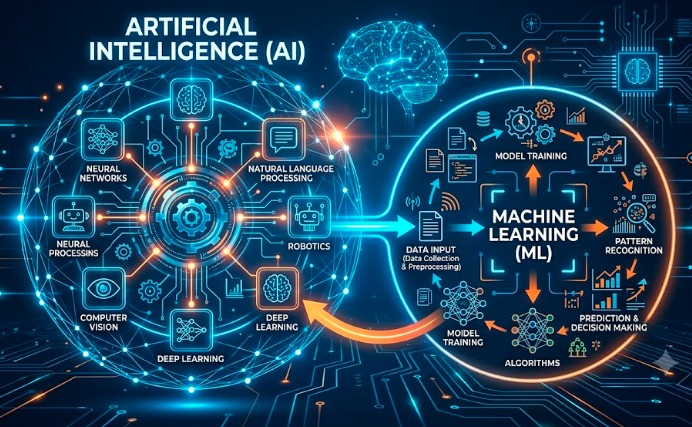
Artificial Intelligence (AI) enables systems to perform tasks that usually require human thinking. Tasks such as analyzing large amounts of data, detecting suspicious activity, and making quick decisions.
Machine Learning (ML) is a part of Artificial Intelligence that helps systems learn from data. Instead of following the same instructions every time, it learns from past cyber threats, recognizes suspicious patterns, and gets better at identifying new threats over time.
The two solutions working together helps organizations:
. Detect unusual activity before it becomes a serious threat.
. Identify phishing attempts and malware more quickly.
. Analyze large amounts of security data in seconds.
. Respond to attacks faster, reducing the damage they can cause.
. Learn from previous attacks and improve their ability to detect future threats.
. Reduce the workload for cybersecurity teams by automating routine security tasks.
Downsides to these advanced solutions
Like every tech-solution, these too have their limitations.
Such as:
. They rely on quality data. If the information they learn from is inaccurate, they may not perform as expected.
. They can sometimes mistake normal activity for a cyber threat or miss a new type of attack.
. They need regular updates because cybercriminals are constantly developing new ways to bypass security systems.
. They cannot replace cybersecurity professionals. Human expertise is still needed to investigate threat and respond to complex attacks.
. Setting up and maintaining these security solutions requires time, skilled professionals, and financial investment.
These downsides aside, AI and Machine Learning are improving cybersecurity.
As cyber threats become more advanced, these solutions help organizations spot potential threats earlier, faster, and better thereby protecting their systems and data.
Note
It’s important to note that AI and ML are not a replacement for people and good cybersecurity practices. Instead, these solutions work alongside them to improve security.
As the digital world expands, using AI and ML together with good security measures will help organizations stay safe from cyber threats.
Thanks for reading!
Loved this post and would love to learn more?
Click below to subscribe.